For debugging and troubleshooting performance issues
As part of hosting of DotNetNuke sites, I often take a look at the processor and memory usage of the various processes running on our servers using Task Manager. Prior to recent changes though, I didn't really have any way to really know which of my sites was really having the biggest impact as all I could really see was a list of the worker processes (w3wp.exe) associated with the app pools. The UserName for each w3wp.exe process was Network Service. I did notice that one of the worker processes, averaged around 14% of the overall utilization while most of them averaged 0% percent with an occasional bump up to 1% or 2%. I figured this must have been one of the busier sites we hosted. I was wrong...
Read More...
Comments (0)
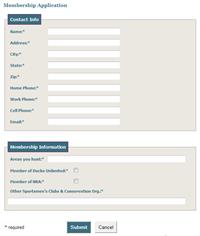
The are lots of very powerful forms modules available for DotNetNuke, but many of them seem like overkill for what we are usually looking for. The Form and List module often meets our functional needs when we are looking for a simple form module but in the past, I was disappointed with the look of the forms it produced.
The Form and List team, (mostly Stefan Cullmann), has done a nice job of adding features to improve the styling options. In particular, I like the ability to use CSS and Separators/Fieldsets for form layout.
Stefan wrote a brief blog showing how he styled the Feedback Form on the formandlist.com site. We used that as our starting point for a membership form we created and found we needed some additional tweaking to get the form looking just right...
Read More...
Comments (1)
Adding the time dimension
This is the first in what we plan on being a 3 part series on improving the tracking and reporting of Ad viewership and clickthroughs within DNN.
Overall, DotNetNuke'sBanner / Ad / Vendor implementation is a nice solution. It does a great job of serving up the appropriate ads based on a nice variety of options. But there's been very little change to the implementation over the last few years and we've found some areas of needed improvement. Efficion is hoping to contribute new features and improvements to these modules based on work we've done to bring it up to the next level.
One of the biggest weaknesses we found was it's reporting capabilities. It's easy enough for us to create reports for our clients (we'll be covering that in Part II of this series) but in this case, we didn't have the data we needed.
Our client wanted to be able to provided statistics on the views and clicks of their ads for a given time period (i.e. September 2010). The problem is, DNN only stores the total number of clicks and views for a given ad. There's no associated time period with those numbers.
So, we need to start storing clicks and views in a way that is time oriented. After some thought on this we decided that we should really accumulate the numbers on daily basis for each ad. Daily seems to be the standard in the analytics world and provides enough granularity to get the time frame you want while also not collecting data at too granular a level.
Daily totals will make it easy to create reports that show totals for a given period or to create trend charts for a particular ad or all ads over a given time period.
Read More...
Comments (2)
This release includes several fixes for incompatibilities introduced by DotNetNuke 5.5.x
Comments (0)
This release includes a great new feature that makes it easy to create articles from external RSS Feeds. If you've ever wanted to pick and choose favorite articles from other sites and let people discuss them on your site, now you can!
In addition, we fixed several fringe bugs and made other underlying enhancements. View full release notes.
Comments (0)